
Labels
I once saw a post from the National Autism Association; it said, “If you must label my child as something, ‘super awesome’ will do just fine.”
I thought it was cute and likely didn’t truly understand what they meant until I dove further into our autism journey. When you first get a diagnosis of autism it’s easy to fall into the need of wanting answers. You’ll explore what autism is and what it means for you or your loved one. As they often say in our community, you’ll learn to look beyond the label and see the able.
The diagnosis is a label. It’s a label that helps someone receive services and support. For some, autism is a diagnosis and for others, it is their identity and for others, it’s both. All are okay. Everyone perceives their autism diagnosis differently.
I no longer view autism as a linear spectrum because when we assess people based on levels, we tend to overlook the person, their personality, their essence, their capabilities. Labeling people as high or low functioning can do more harm than good.
Laura Tisoncik an autistic advocate stated, “Low functioning means our abilities are not acknowledged. High functioning means our challenges are not addressed.”
For me that was a huge wakeup call. I had initially been taught to see autism as this stereotyped line and people HAD to fit in at a specific point. But autism is really more of a color wheel. Check out the color wheel to the right. I think this is a more realistic interpretation of the spectrum. There are multiple areas of the wheel. Things like stimming, anxiety, communication, repetitive behaviors, etc. And each autistic person has their own level within each area. Everyone’s journey is unique, each person is unique. And we should honor that.
So I challenge you to throw out the high vs. low functioning labels and learn to see someone on the spectrum for their true potential and self. Using terms like high functioning could also prevent you from getting services because you’re implying the person may not need supports. When I worked with children in foster care, we would refer to things as our strengths and needs instead of weakness because weakness implied it couldn’t improve. Someone may have a need to change in certain areas, like a reduction in anxiety or self harming behaviors. And perhaps their strength is communication but that strength should not hide their needs.
You are a beautiful human being. We all deserve to be included and belong. You ARE awesome!
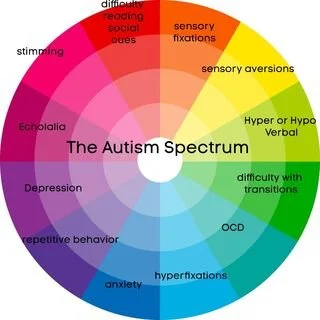
Source: Psychology Today, Jessica L. Penot, LPC-S
